Which Technology Stack Is Best For Building Scalable Web Applications?
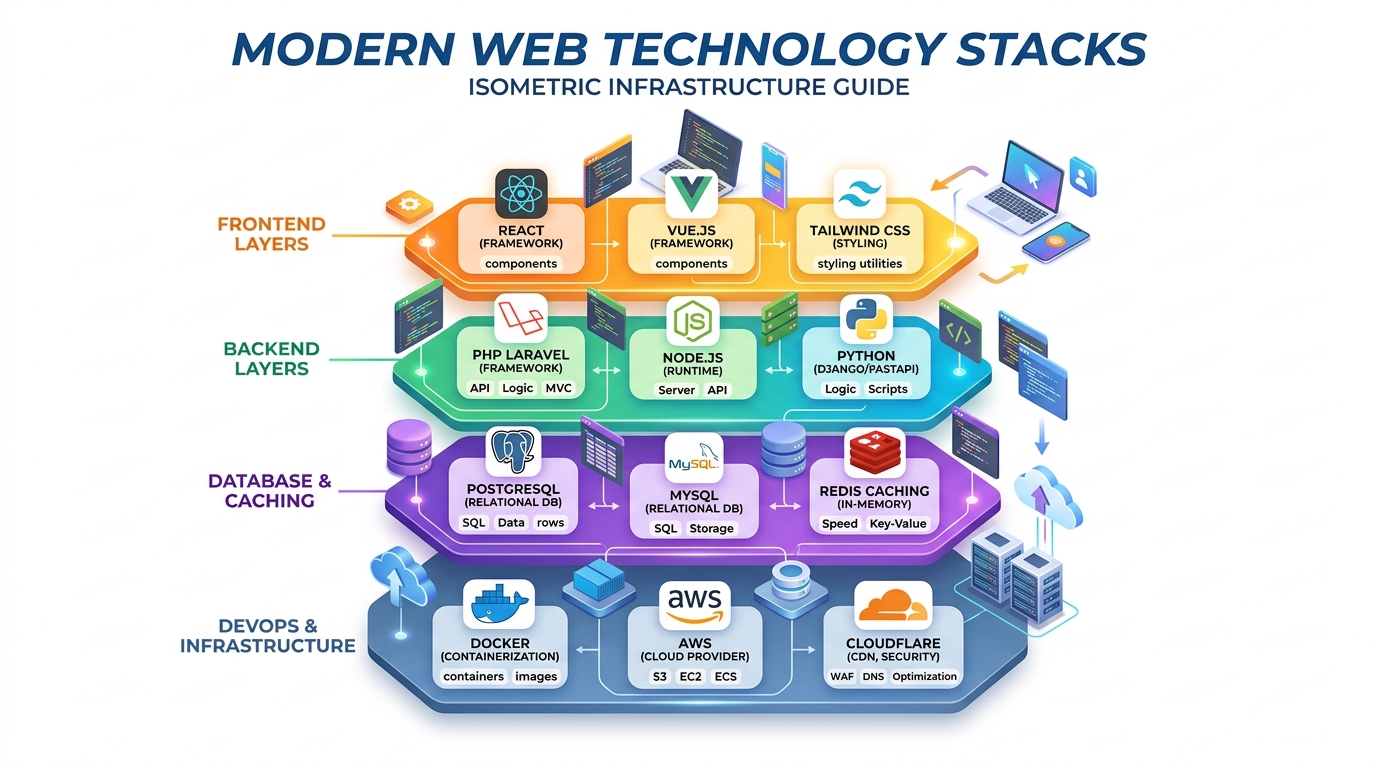
Chasing shiny tech trends is the fastest way to bankrupt a software project.
Every six months, a new JavaScript framework appears, promising to revolutionize web architecture. Teams rewrite perfectly functioning codebases to follow social media hype, only to discover the new framework lacks mature database ORMs, documentation, or security patches.
Selecting the best technology stack for web applications is about balancing velocity, ecosystem maturity, developer talent availability, and battle-tested scalability under high loads.
Here is the objective engineering blueprint for choosing a rock-solid tech foundation.
The Executive TL;DR / Battle-Tested Recommendations
- The High-Velocity Monolith: PHP 8+ (Laravel) + PostgreSQL + Tailwind CSS. Unmatched delivery speed, built-in authentication, queue management, and ultra-affordable talent pool.
- The Real-Time Event Engine: Node.js (TypeScript) + React + Redis. Ideal for collaborative real-time whiteboards, instant messaging, and IoT telemetry ingestion.
- The Cloud Data Powerhouse: Python (FastAPI) + PostgreSQL + React. The definitive choice when machine learning pipelines, NLP models, or heavy mathematical computations drive your core product.
- Architectural Consensus: According to the AWS Well-Architected Framework , horizontal database caching and decoupled stateless backends matter far more to scalability than your choice of programming language.
What Technology Stack Is Best for Scalable Web Applications?
The best technology stack for scalable web applications combines a proven, high-productivity backend framework like PHP 8 (Laravel) or Node.js, a robust relational database like PostgreSQL, an in-memory caching layer like Redis, and a responsive frontend library like React or Tailwind CSS.
True scalability comes from architectural decoupling, database indexing, and caching—not from esoteric programming languages.
The Core Layers of Modern Scalable Architecture
Here is how each layer of the tech stack functions in harmony.
1. The Presentation Layer (Frontend)
Modern web interfaces demand responsiveness, accessibility, and speed. Utilizing React or clean modern Tailwind CSS ensures lightning-fast client rendering without bloated dependencies. Learn how our development process crafts intuitive user journeys.
2. The Business Logic Engine (Backend)
The backend manages data validation, payment processing, and security permissions. Frameworks like Laravel or Node.js provide robust middleware pipelines that protect against CSRF attacks, injection vulnerabilities, and race conditions. Check out our custom software development services.
3. The Data Persistence Layer (Database & In-Memory Cache)
PostgreSQL handles relational data with ACID compliance and JSONB flexibility. Paired with Redis, frequently accessed queries are served in sub-millisecond speeds, reducing database load by over 80%.
4. Edge Infrastructure and CDN Acceleration
Protecting your origin server through Cloudflare provides global DDoS mitigation, automatic SSL termination, and static asset distribution across 300+ global edge locations.
Tech Stack Comparison Matrix
| Technology Stack Combination | Development Velocity | Scalability Potential | Talent Availability | Best Fit Use Case |
|---|---|---|---|---|
| PHP 8 / Laravel + PostgreSQL | Extremely High | High to Enterprise | Abundant & Affordable | SaaS platforms, eCommerce, Enterprise CMS |
| Node.js / Express + MongoDB | High | High (I/O intensive) | Very Abundant | Real-time chat, collaborative tools, streaming |
| Python / FastAPI + Postgres | Moderate to High | High | Abundant | AI/ML wrappers, financial analytics, data science |
| Go (Golang) + PostgreSQL | Moderate | Extreme (Microservices) | Rare & Expensive | High-throughput fintech, network gateways |
Step-by-Step Strategy: How to Select Your Product's Stack
Follow this pragmatic vetting sequence:
- Audit Your Talent Pool and Maintenance Budget
Choosing an exotic language like Rust or Elixir might sound exciting to a junior engineer, but finding replacement senior developers down the road will cost $180/hr. Choosing Laravel or Node.js ensures a vast global talent marketplace.
- Evaluate Your Read-to-Write Ratio
If 95% of your application's activity is users reading content (like in an academic portal or directory), aggressive Redis caching on a standard relational database handles millions of daily hits effortlessly.
- Separate Your Frontend and Backend via Clean APIs
Building a RESTful or GraphQL API backend allows you to swap or update your user interface years later without ever touching your underlying business logic or database schemas. Review our case studies on our work page.
The Non-Obvious Pitfall: Premature Microservices Architecture
The single biggest engineering trap modern startups fall into is adopting a microservices architecture on day one.
Junior architects read about Netflix or Uber managing 500 microservices and assume their early-stage web app requires the same complexity.
They spend six months managing Docker container networks, distributed tracing, and Kubernetes clusters instead of talking to customers. Build a clean, modular monolith first. A well-architected Laravel or Node application can easily scale to 500,000 active users before microservices are ever required.
Architect Your Application for Long-Term Scale
Do not guess when it comes to your core technology stack. Take decisive action:
- Write down your anticipated concurrency load for the next 12 months.
- Reach out to App Craft Services to receive an objective, unbiased architectural recommendation tailored to your budget and growth targets.
Build on stone, not shifting sand.