What Security Standards Are Necessary For Custom Web Applications?
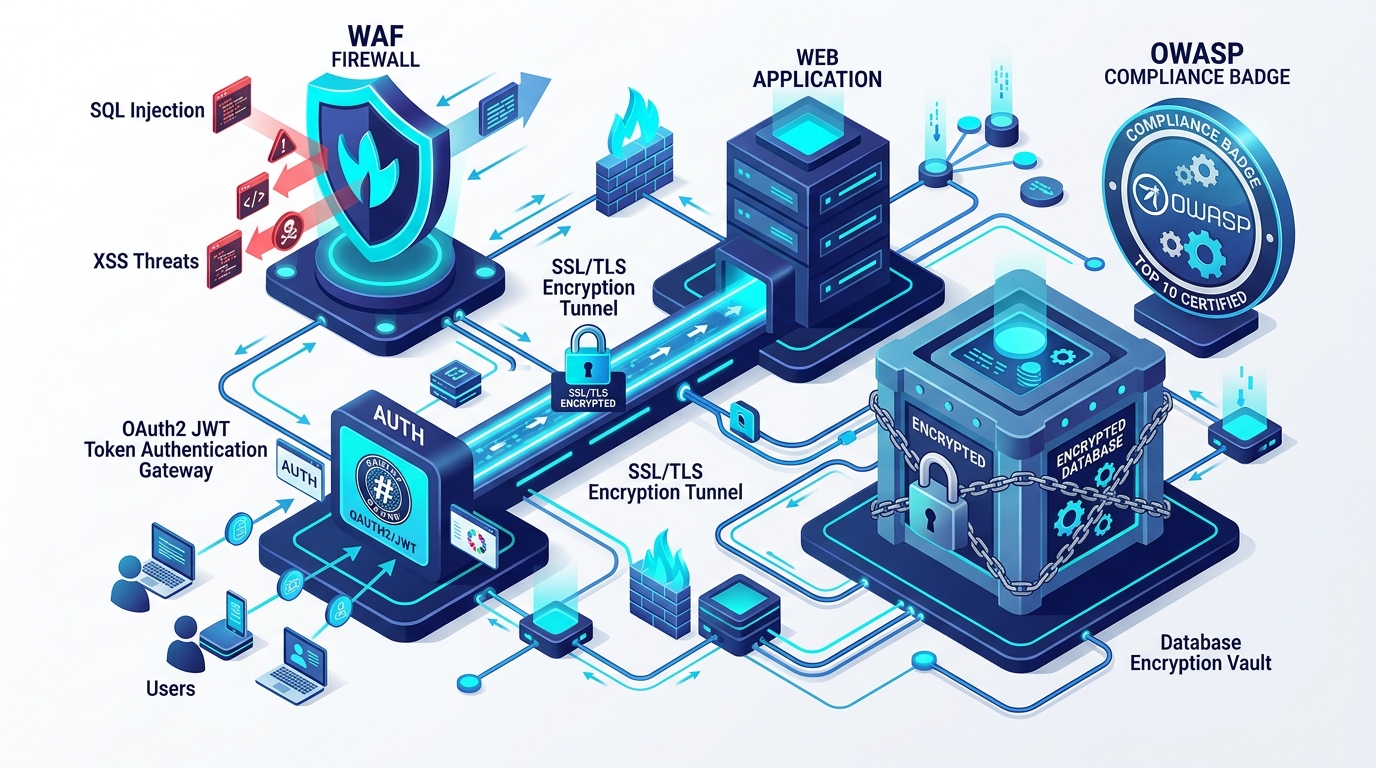
Security is never an afterthought; it is the perimeter foundation of your business.
A single data breach does not just crash your servers; it destroys customer trust, triggers crippling regulatory fines, and wipes out millions in brand equity overnight. In 2026, cyberattacks on business web applications are fully automated, volumetric, and relentless.
Adhering to rigorous custom web application security standards is what protects your customer data and safeguards your operational reputation.
Here is the essential cybersecurity blueprint required for modern web applications.
The Executive TL;DR / Critical Security Controls
- OWASP Top 10 Mitigation: Hardened defenses against SQL Injection, Cross-Site Scripting (XSS), and Broken Object Level Authorization (BOLA).
- Edge Layer Defense (WAF & Rate Limiting): Provisioning Web Application Firewalls to filter malicious payloads before traffic reaches your application server.
- Encryption Everywhere: Mandatory HTTPS/TLS 1.3 in transit with HSTS preload, paired with AES-256 encryption for sensitive data at rest.
- Compliance Frameworks: Adherence to the OWASP Foundation Standards and NIST Cybersecurity Framework .
What Security Standards Are Required for Custom Web Apps?
Custom web applications require comprehensive security protocols, including OWASP Top 10 compliance, edge Web Application Firewalls (WAF), TLS 1.3 data-in-transit encryption, AES-256 database encryption at rest, secure role-based access control (RBAC), and automated vulnerability auditing pipelines.
Security must be implemented at every tier of the architecture, from DNS routing to database queries.
The 4 Defensive Layers of Enterprise Web Security
Here is how modern secure software defends itself in production.
1. Edge Layer: WAF, DDoS Mitigation & Rate Limiting
Before a malicious HTTP request reaches your PHP or Node backend, an edge firewall like Cloudflare inspects traffic signatures, enforces rate limiting, and blocks SQL injection payloads. Learn how our development process integrates edge security.
2. Transport Layer: Strict Transport Security (HSTS)
We enforce HTTPS traffic redirects alongside the HTTP Strict Transport Security (Strict-Transport-Security: max-age=31536000; includeSubDomains; preload) header, preventing SSL stripping and man-in-the-middle attacks.
3. Application Layer: Sanitization & Parameterized Queries
Preventing database injection attacks requires utilizing Object-Relational Mappers (ORMs) or prepared statements with parameterized SQL queries. Never concatenate raw user input into a SQL string. Check out our custom software development services.
4. Authentication & Authorization: RBAC & Token Security
We implement stateless JWT tokens or encrypted HTTP-only session cookies with SameSite=Strict flags to mitigate Cross-Site Request Forgery (CSRF). Role-based access control ensures regular users cannot access administrative endpoints.
Security Vulnerability & Defense Matrix
| Vulnerability Vector | Attack Mechanism | Engineering Defense & Mitigation |
|---|---|---|
| SQL Injection (SQLi) | Injecting malicious SQL syntax into form inputs | Parameterized queries & ORM prepared statements |
| Cross-Site Scripting (XSS) | Injecting executable JavaScript into views | Strict input sanitization & Content Security Policy (CSP) |
| Broken Access Control | Manipulating URL IDs to view others' private data | Server-side authorization gates on every record request |
| Credential Stuffing | Automated brute-force login attempts | Edge rate-limiting, IP throttling, and multi-factor auth |
| Man-in-the-Middle | Intercepting unencrypted public WiFi traffic | Mandatory TLS 1.3 and HSTS preload headers |
Step-by-Step Hardening: How to Audit Your Application
Follow this essential security verification sequence:
- Inject HTTP Security Headers into Server Configuration
Verify that your .htaccess or Nginx configuration serves:
- Content-Security-Policy
- X-Frame-Options: SAMEORIGIN
- X-Content-Type-Options: nosniff
- Referrer-Policy: strict-origin-when-cross-origin
- Automate Dependency Vulnerability Scanning
Utilize npm audit or composer audit inside your continuous integration (CI) pipeline to catch outdated libraries with known CVE exploits before deployment.
- Enforce Database Encryption at Rest
Ensure database volumes use full-disk AES-256 encryption, and hash all user passwords using modern adaptive algorithms like Argon2id or Bcrypt. Explore our proven client builds on our work page.
The Non-Obvious Pitfall: The "Security Through Obscurity" Illusion
The most widespread security blunder is assuming hackers won't find your administration page because you changed the URL from /admin to /secret-admin-portal-2026.
Automated botnets do not guess URLs; they scan IP ranges, analyze server response headers, inspect JavaScript bundle source maps, and spider every API route.
Obscurity is not security. Robust, cryptographic access control that rejects unauthorized requests regardless of the URL is the only defense that stands up to automated scanners.
Fortify Your Web Application with Enterprise-Grade Defenses
Do not wait for a security incident to expose architectural vulnerabilities. Take proactive action:
- Run an automated security header scan on your current production website.
- Contact App Craft Services to schedule a comprehensive application security audit and vulnerability penetration assessment.
Protect your data. Safeguard your business.