What Is The Difference Between Custom Software And Off-the-shelf Software?
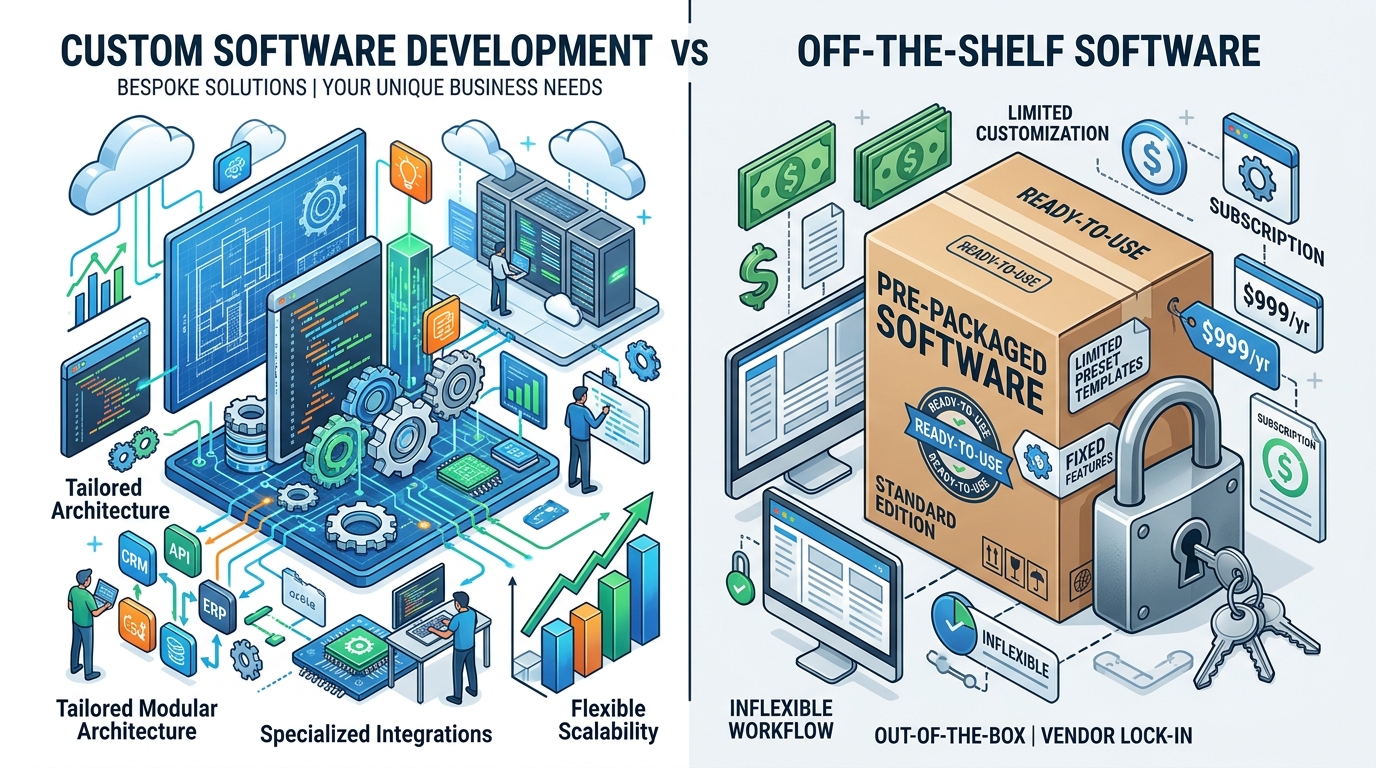
Renting someone else's tools will eventually cap your revenue.
Standard packaged software feels comfortable on day one, like buying an off-the-rack suit that fits adequately around the shoulders. But when your enterprise expands into proprietary workflows, bespoke compliance mandates, and high-frequency transactions, that off-the-rack fabric tears apart at the seams.
Choosing between custom software and off-the-shelf software is not merely a technical decision; it is a foundational capital allocation choice that dictates your competitive defensibility.
Here is the exact framework to decide which path fuels your growth.
The Executive TL;DR / Decision Matrix
- Off-the-Shelf (COTS): Low upfront capital ($50–$500/month/user), immediate 24-hour onboarding, zero technical maintenance burden, but zero workflow customization and endless recurring seat licenses.
- Custom Software Engineering: Upfront capital investment ($25,000–$150,000+), 2 to 6 months build cycle, complete intellectual property ownership, zero per-seat licensing penalties, and 100% architectural freedom.
- The Growth Pivot: According to Gartner Research , enterprises that migrate from rigid SaaS monoliths to tailored internal platforms report an average 32% reduction in multi-year operational overhead.
What Is the Real Difference Between Custom and Off-the-Shelf Software?
Custom software is built from the ground up to match an organization's specific operational requirements, while off-the-shelf software is mass-produced for the broad commercial market with standardized feature sets. Custom platforms grant full source code ownership, whereas off-the-shelf tools require recurring subscription licenses without codebase control.
One is an asset on your balance sheet. The other is a perpetual monthly expense with strict vendor guardrails.
The Strategic Anatomy: Tailored Ownership vs. Subscription Rental
Think about a standard Tuesday morning in your operations hub.
Your logistics team discovers an opportunity to automate freight manifest calculations using a specialized machine learning model. With off-the-shelf software, your request is relegated to a public vendor forum where it sits behind 4,000 other upvotes for three years. With custom architecture, your engineering team provisions the endpoint in a two-week sprint.
1. Financial Mechanics and Total Cost of Ownership (TCO)
Off-the-shelf software seduces leaders with cheap entry pricing. But calculate the math across 150 employees: at $85 per user per month, you are spending $153,000 every single year without building a shred of equity. Custom development converts operational expense into an appreciating proprietary digital asset. Review our transparent pricing models to calculate your long-term capital ROI.
2. Workflow Adaptability and Process Integration
Off-the-shelf applications force your staff to contort their proven operational workflows to match the software's rigid UX design. Custom systems bend entirely around your staff's natural productivity habits. Learn how our custom software development services engineer frictionless interfaces.
3. Data Sovereignty and Security Governance
When you use public SaaS, your proprietary corporate intelligence resides on shared multi-tenant databases subject to third-party vulnerability exposures. Custom web applications enforce dedicated encryption keys compliant with the NIST Cybersecurity Framework and OWASP guidelines.
Direct Comparison Matrix
| Operational Criterion | Custom Software Solution | Commercial Off-the-Shelf (COTS) |
|---|---|---|
| Initial Upfront Cost | Moderate to High ($25,000 – $150,000+) | Low initial setup ($0 – $5,000) |
| Long-Term Recurring Cost | Minimal (Infrastructure hosting & upkeep) | Continuous recurring fees per seat |
| Feature Customization | 100% bespoke to your business logic | Restricted to predefined vendor settings |
| Third-Party API Agility | Unlimited direct REST/GraphQL webhooks | Restricted to approved vendor app store |
| Source Code & IP Rights | 100% client intellectual property | Owned entirely by the SaaS vendor |
| Time to Deployment | 6 to 16 weeks via agile sprints | Instantaneous / 1 to 2 weeks configuration |
Step-by-Step Evaluation: How to Choose the Right Model
Follow this battle-tested decision formula before signing any software contract:
- Calculate Your 3-Year Seat Escalation Tax
Multiply your projected headcount growth across 36 months of SaaS seat licensing. If the cumulative figure exceeds $60,000, a bespoke solution yields positive cash-flow dividends by year two.
- Isolate Your Unique Competitive Moat
If a business process represents your core competitive advantage in the market, never run it on the same generic tool your competitors can rent for $49 a month. Automate that moat with custom engineering.
- Audit Your Integration Surface Area
Examine your existing ERP, accounting pipelines, and CRM systems. If connecting off-the-shelf tools requires fragile Zapier glue and duct tape, custom middleware built through our agile development process will eliminate data corruption.
The Non-Obvious Pitfall: The "SaaS Customization" Financial Abyss
The costliest blunder enterprises make is purchasing a generic off-the-shelf enterprise platform (like Salesforce or SAP) and attempting to aggressively recode it into a custom animal.
Agencies charge $250 an hour to write proprietary wrappers around restricted vendor APIs.
Six months in, a mandatory vendor platform update arrives and breaks every single custom extension. You end up paying enterprise subscription prices while also paying custom development maintenance fees. If you need bespoke behavior, build a native custom foundation from day one.
Take Decisive Action on Your Software Infrastructure
Stop renting generic software that suffocates your operational expansion. Take these two concrete steps today:
- Map the three largest operational bottlenecks in your current software suite.
- Reach out to App Craft Services for an architectural audit and discover how custom web software will transform your balance sheet.
Own your code. Control your destiny.