What Does "Cloud-native Architecture" Mean In Web Development?
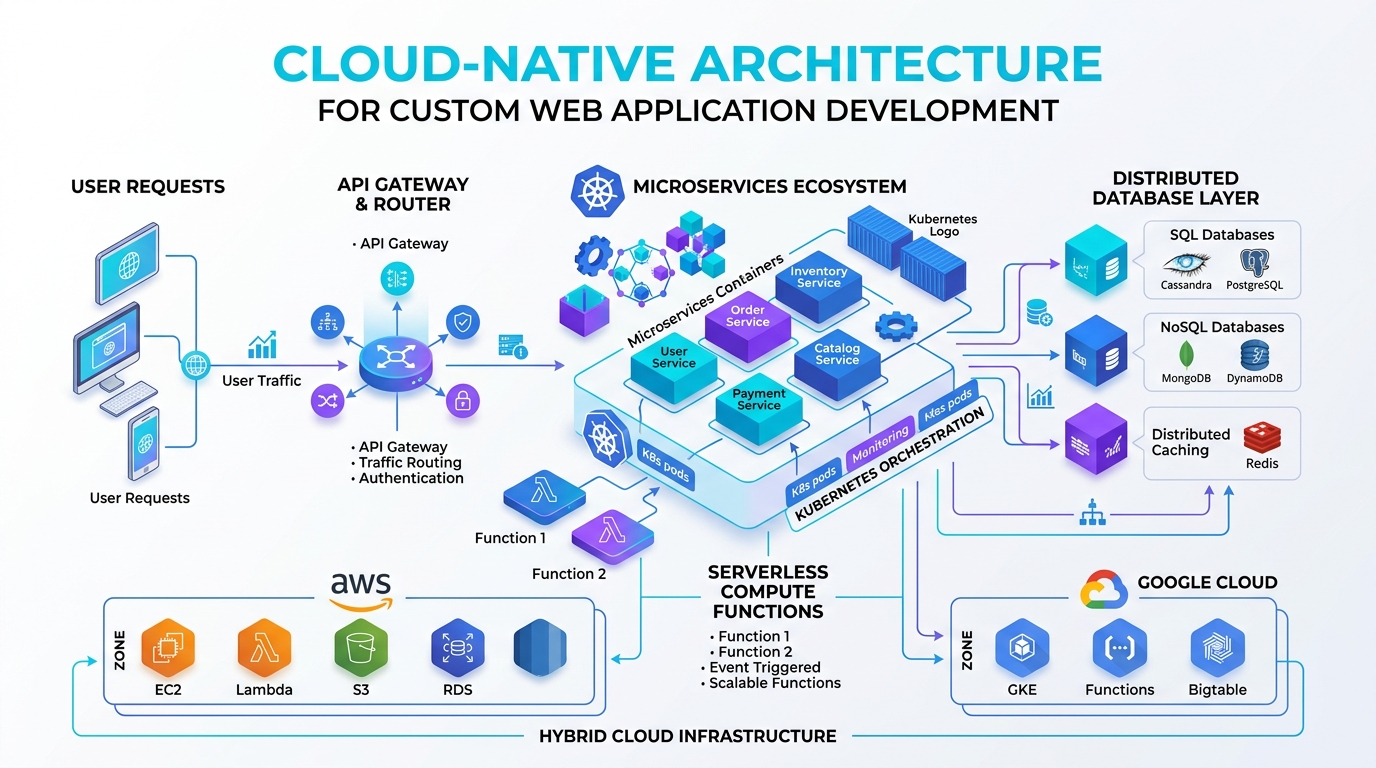
Renting virtual servers is not the same as being cloud-native.
Simply taking an old, monolithic legacy application and lifting-and-shifting it onto an Amazon EC2 instance is like strapping jet engines onto a horse-drawn buggy. You pay exorbitant cloud bills without getting any of the resilience, self-healing elasticity, or lightning speed the cloud promises.
Understanding cloud-native architecture is what separates fragile servers that crash under Black Friday traffic from bulletproof digital platforms that effortlessly absorb viral spikes.
Here is what cloud-native engineering actually means for your bottom line.
The Executive TL;DR / Core Architectural Tenets
- Containerization: Packaging application code with dependencies using Docker ensures identical execution across local, staging, and production environments.
- Dynamic Orchestration: Utilizing Kubernetes or managed container runners to automatically provision and kill instances based on real-time traffic demand.
- Microservices & Stateless Compute: Decoupling application functions so an error in your reporting module never takes down your payment checkout engine.
- The Cloud Standard: According to the Cloud Native Computing Foundation (CNCF) , organizations adopting cloud-native architectures report a 44% improvement in release frequency and a 38% reduction in mean time to recovery (MTTR).
What Does Cloud-Native Architecture Mean in Web Development?
Cloud-native architecture is an engineering approach designed specifically to build and run scalable web applications within modern cloud environments like AWS and Google Cloud. It leverages containerization, declarative APIs, stateless microservices, and automated continuous delivery pipelines to ensure high availability and horizontal elasticity.
It is software engineered specifically to thrive in the cloud, rather than merely endure it.
The 4 Pillars of Cloud-Native Infrastructure
Let us examine the operational mechanisms powering a cloud-native platform.
1. Immutable Infrastructure via Containers
Containers bundle application code, system libraries, and runtime configurations into a lightweight, portable unit. Developers test the exact container image locally that runs in production. Discover how our development process utilizes containerized staging environments.
2. Microservices and Decoupled Service Meshes
Rather than building an enormous single codebase where a single null pointer exception halts the whole enterprise, cloud-native systems separate concerns into dedicated services communicating over lightweight REST or gRPC protocols. Explore our custom software development services.
3. Serverless Compute and Event-Driven Pipelines
Cloud-native apps offload background processing to event-driven workers. When a customer uploads a 50MB PDF, background lambda workers process the document asynchronously without degrading web interface responsiveness.
4. Continuous Delivery and Observability
Automated CI/CD pipelines deploy code updates several times a day with zero user downtime. Integrated telemetry monitoring with AWS CloudWatch and OpenTelemetry catches latency regressions instantly.
Cloud-Native vs. Traditional Monolithic Hosting
| Infrastructure Dimension | Traditional Monolith ("Lift-and-Shift") | Cloud-Native Web Architecture |
|---|---|---|
| Server Provisioning | Manual VM setup & static hardware sizing | Automated dynamic container scaling |
| Downtime & Deployments | Scheduled midnight maintenance windows | Zero-downtime rolling canary deployments |
| Fault Isolation | Single error crashes the entire application | Fault isolated to specific microservice |
| Cost Model | Paying 24/7 for peak capacity idle servers | Pay-for-actual-compute consumption |
| Disaster Recovery | Hours or days of manual database restoration | Automated multi-region failover in minutes |
Step-by-Step Transition: How to Modernize Your Stack
Follow this measured evolutionary path:
- Dockerize Your Application Runtime
Begin by standardizing your runtime dependencies inside a Dockerfile. Eliminate "it works on my machine" excuses forever.
- Decouple Session State from the Application Tier
Move user session storage, file uploads, and background queues out of local disk storage and into distributed engines like Redis and Amazon S3. Stateless servers can be destroyed and multiplied effortlessly.
- Implement Edge Caching and SSL Termination
Place your web ingress behind Cloudflare to absorb DDoS traffic and cache static assets globally. Check our work case studies to see how our clients scale securely.
The Non-Obvious Pitfall: Over-Engineering for Imaginary Scale
The most dangerous pitfall in cloud-native development is adopting distributed microservices before reaching product-market fit.
Founders read about Google running billions of containers and assume their 500-user web application requires a multi-cluster Kubernetes service mesh.
The resulting operational complexity drains development velocity. Start with a containerized modular monolith on managed cloud services. Migrate to microservices only when independent team boundaries or extreme traffic bottlenecks require it.
Build Resilient Cloud-Native Web Applications
Stop fearing server crashes and traffic surges. Take decisive action today:
- Audit your current server hosting bills and identify idle resource waste.
- Contact App Craft Services to architect a scalable, cost-effective cloud-native roadmap tailored to your specific application requirements.
Resilience is engineered, not wished for.