What Are The Phases Of The Custom Software Development Life Cycle?
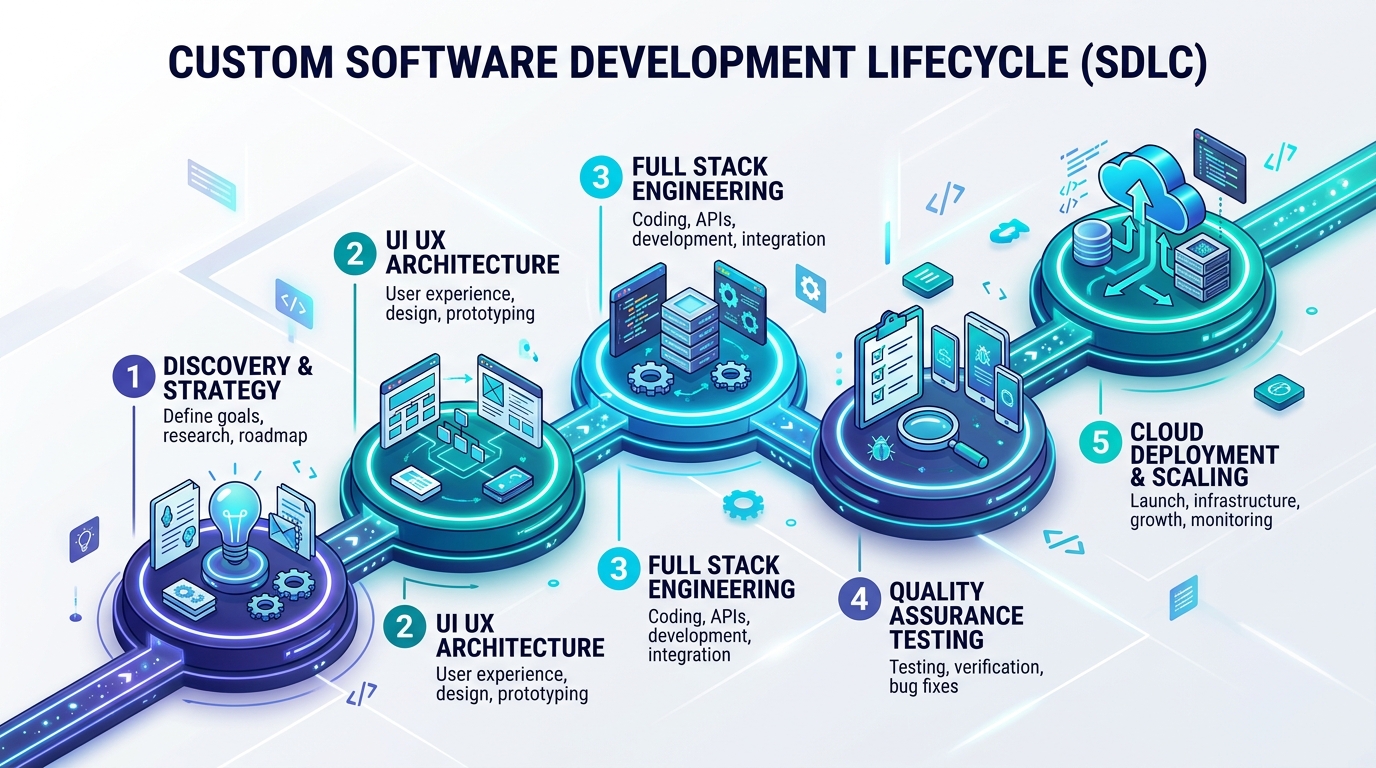
Software without methodology is just improvised chaos.
When developers jump straight into coding before understanding the domain logic, they are building a skyscraper on loose sand. Every structural shortcut taken in week two creates catastrophic cracking by month six.
The custom software development life cycle (SDLC) is the rigorous engineering roadmap that transforms an ambitious business concept into an invincible, revenue-generating digital asset.
Here is the exact step-by-step breakdown of how world-class software is engineered.
The Executive TL;DR / The 6 Lifecyle Pillars
- Phase 1 (Discovery & Architecture): Technical feasibility, entity-relationship diagrams, and risk audits.
- Phase 2 (UI/UX Journey Mapping): Wireframing, design systems, and rapid prototyping.
- Phase 3 (Full-Stack Engineering): Modular backend logic, API contracts, and responsive frontend views.
- Phase 4 (Quality Assurance & Security): Automated regression, penetration testing, and load stress audits.
- Phase 5 (Cloud Deployment): Zero-downtime CI/CD pipelines, SSL enforcement, and server monitoring.
- Phase 6 (Maintenance & Evolution): Continuous security patching, performance tuning, and scaling.
What Are the Six Phases of the Custom Software Development Life Cycle?
The custom software development life cycle consists of six foundational phases: Requirements Discovery, UI/UX Design, Development Engineering, Quality Assurance Testing, Deployment, and Ongoing Maintenance. This structured sequence ensures code quality, prevents budget overruns, and guarantees system stability.
Following this framework guarantees that your software solves the right problem the right way on the first attempt.
The Engineering Mechanism: How High-Performance Teams Execute Each Phase
Let us break down how our senior engineering team executes each stage during a standard engagement.
1. Requirements Discovery and Technical Architecture
We audit existing business processes, isolate data entities, and define security boundaries. The output of this phase is not a vague brainstorm; it is a concrete Technical Specification Document containing database schema maps and API endpoint specifications. Learn more about our thorough discovery process.
2. UI/UX Interface Design and User Flow Mapping
Great software feels invisible to the end user. We build high-fidelity interactive Figma prototypes to simulate every mouse click, form submission, and error state. Review our client case studies on our work portfolio.
3. Backend and Frontend Full-Stack Engineering
Using modern agile sprints, we construct the backend logic (PHP 8, Laravel, Node.js), provision secure relational databases (PostgreSQL, MySQL), and connect interactive client-side interfaces. Explore our full suite of custom software development services.
4. Quality Assurance and Security Verification
Code is subjected to unit tests, integration tests, and automated vulnerability scanning adhering to OWASP Cybersecurity Standards .
5. Production Cloud Deployment and Infrastructure Provisioning
We configure production environments using Nginx, edge CDN caching via Cloudflare , and automated continuous deployment scripts that eliminate manual human error.
6. Maintenance, Monitoring, and Performance Optimization
Production systems require ongoing care. We monitor uptime telemetry, patch server dependencies, and optimize slow database queries as user traffic multiplies.
SDLC Phase Comparison Matrix
| SDLC Phase | Core Objective | Key Deliverables | Risk Mitigated |
|---|---|---|---|
| 1. Discovery | Define system boundaries | Technical spec, DB schemas | Scope creep & architectural failure |
| 2. UI/UX Design | Optimize user productivity | Interactive Figma mockups | Poor user adoption & UX confusion |
| 3. Development | Write scalable clean code | Functional API & frontend | Brittle codebase & technical debt |
| 4. QA Testing | Verify stability & security | Automated test suites | Production downtime & data leaks |
| 5. Deployment | Launch to end users | Live production environment | Deployment downtime & server misconfigurations |
| 6. Maintenance | Preserve system health | Security patches & backups | Security vulnerabilities & slow bitrot |
Step-by-Step Implementation: How to Ensure Your Project Adheres to the SDLC
To ensure your development project stays on track and within budget:
- Refuse to Write Code Without an Approved Schema
Never allow an agency to begin coding until the entity-relationship diagram (ERD) is completed and signed off. A flaw in the database design caught on paper takes 10 minutes to fix; the same flaw caught in production takes three weeks of painful migration.
- Demand Working Demos Every 14 Days
Agile methodology relies on tangible output. Insist on inspecting a functional staging build at the conclusion of every two-week sprint to verify progress firsthand.
- Enforce Automated Regression Testing Before Launch
Ensure your developers build automated test suites so that adding a new feature next year will never inadvertently break your payment gateway or user login system.
The Non-Obvious Pitfall: Skipping the Discovery Phase
The single most destructive mistake in business software development is skipping Phase 1 to "save time and money."
Clients who insist on jumping directly to Phase 3 inevitably discover mid-way through development that their chosen database architecture cannot support their reporting requirements, or that a critical third-party API lacks the necessary endpoints.
Reworking architecture mid-flight costs up to 500% more than discovering the constraint during the initial audit. Proper discovery is not a delay; it is insurance.
Build Your Next Application with Engineering Rigor
Do not leave your software project to chance or unproven guesswork. Take the right step forward:
- Review your project's current maturity and list your critical business deliverables.
- Contact App Craft Services to initiate a structured technical discovery and bring your vision to life with complete architectural clarity.
Measure twice. Code once.