How Much Does Custom Software Development Cost?
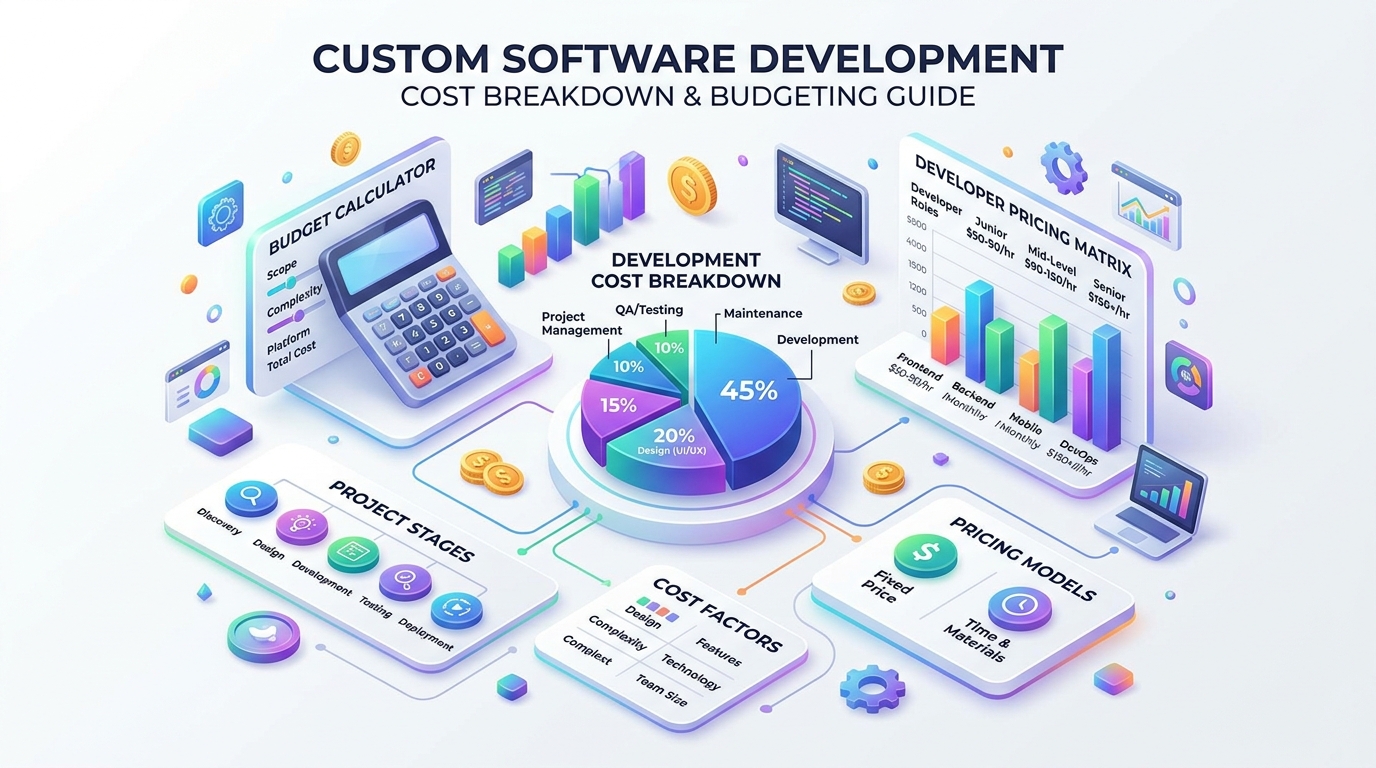
Price tags lie.
Buying bespoke software is not like walking into a showroom and driving off in a shiny sedan with a fixed sticker price; it is more like hiring a master builder to construct an earthquake-resistant glass architectural pavilion on shifting coastal bedrock.
Understanding the true custom software development cost determines whether your digital transformation sparks measurable market domination or bleeds your capital balance dry.
Here is exactly how to calculate, budget, and control every dollar.
The Executive TL;DR / Key Budget Realities
- Entry-Level MVP / Prototype: $18,000 – $45,000 (Timeline: 6–10 weeks)
- Mid-Tier Commercial Web Application: $45,000 – $120,000 (Timeline: 3–6 months)
- Enterprise-Grade Distributed Platform: $120,000 – $350,000+ (Timeline: 6–12+ months)
- The 20% Rule: According to research published by IEEE Computer Society and leading software engineering standards, organizations should allocate 15% to 20% of their total upfront development budget each year for ongoing maintenance, security patching, and infrastructure scaling.
What Is the True Cost of Custom Software Development?
The cost of custom software development ranges from $25,000 for a streamlined minimum viable product to over $250,000 for an enterprise-grade cloud application. Final budgets depend on technical architectural complexity, third-party API integrations, security compliance mandates, and developer team geography.
Scope dictates checks. You can build a lightweight internal workflow tracker in four weeks with clean PHP and PostgreSQL, or spend nine months crafting a multi-tenant healthcare engine subject to strict U.S. Department of Health and Human Services (HHS) HIPAA Guidelines and AWS Well-Architected Framework standards.
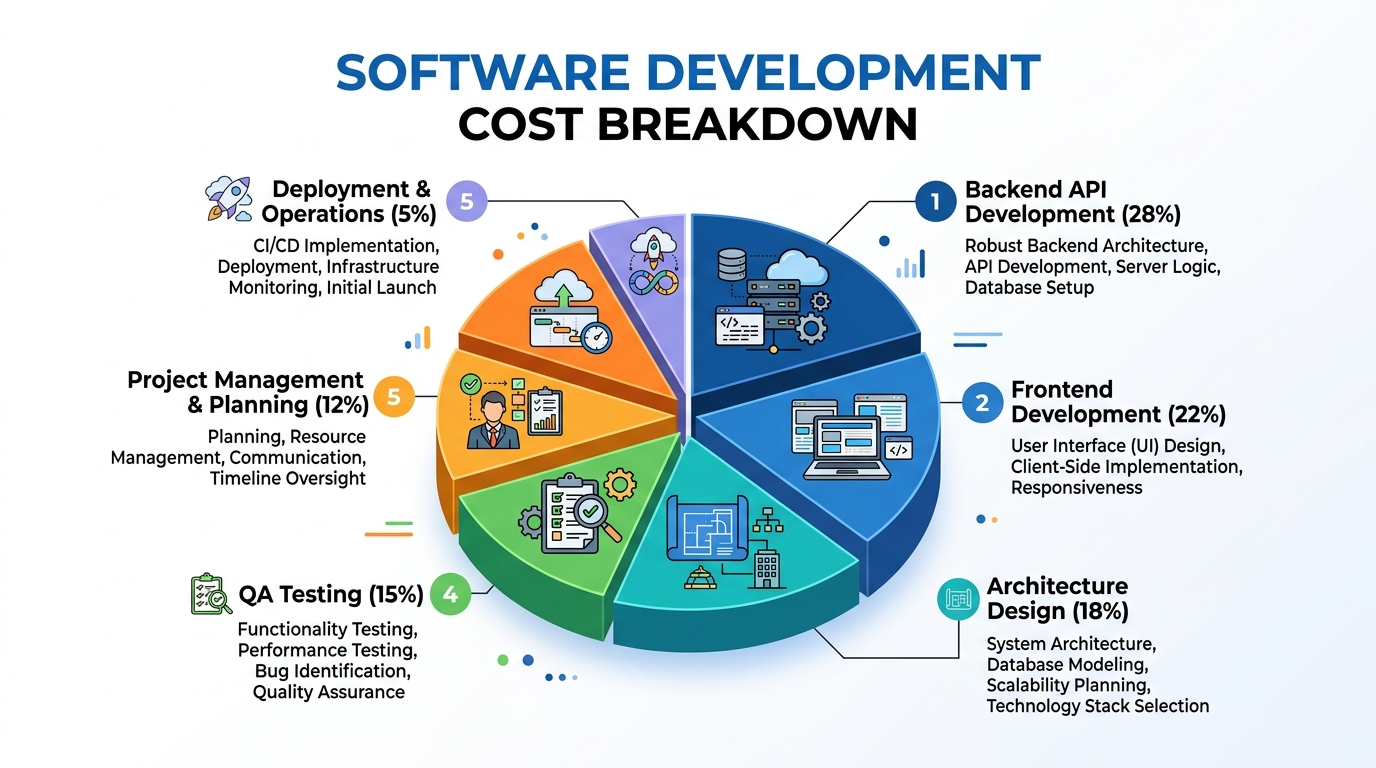
The Core Financial Anatomy: Where Your Budget Actually Goes
Let us dispel the biggest illusion in tech: you are never paying engineers merely to hammer out lines of code.
Think about a standard Tuesday morning in an active sprint: your lead solutions architect is whiteboarding a Redis caching layer to survive flash traffic, while your QA automation engineer writes end-to-end Cypress tests so payments never bounce. Code without architecture is technical debt borrowed at predatory interest rates.
1. Architecture, Discovery, and Database Modeling (15% – 20%)
Skipping comprehensive technical discovery is the fastest way to double your total expenditure down the road. This phase converts abstract business requirements into explicit entity-relationship diagrams (ERDs), API contract schemas, and cloud topology maps. Explore how our structured development process minimizes technical risk before writing a single line of production code.
2. UI/UX Interface Design and User Journey Mapping (15% – 20%)
Attractive interfaces retain users; intuitive workflows make them pay. Wireframing, interactive prototyping in Figma, and usability audits ensure your team never writes code for features customers will abandon. Check out our real-world client builds on our work portfolio page.
3. Backend Engine, Business Logic, and Database Construction (30% – 35%)
The engine room. This involves building REST or GraphQL microservices, authentication security layers, background worker queues, and resilient database indices. We specialize in building robust backend systems through our dedicated custom software development services.
4. Frontend Client-Side Engineering (20% – 25%)
Translating interactive designs into pixel-perfect, accessible, and ultra-responsive web interfaces that render instantaneously across mobile screens, tablets, and desktop workstations.
5. Quality Assurance, Security Hardening, and Deployment (10% – 15%)
Regression testing, penetration vulnerability audits compliant with the OWASP Top 10 Security Standards , automated CI/CD pipeline deployments, and load testing under synthetic traffic spikes.
The 4-Tier Development Pricing Spectrum
| Tier Classification | Investment Range | Typical Timeline | Typical Scope & Capabilities |
|---|---|---|---|
| Tier 1: Scoped Prototype / MVP | $18,000 – $40,000 | 6 – 8 Weeks | Core value proposition, clean authentication, single payment gateway, simple database schema. |
| Tier 2: Growth-Stage SaaS Product | $45,000 – $95,000 | 3 – 5 Months | Multi-role user access, CRM sync, real-time analytics dashboard, automated email workflows. |
| Tier 3: Enterprise Web Portal | $100,000 – $220,000 | 5 – 9 Months | High-throughput data ingestion, custom CMS/OJS workflows, enterprise ERP integrations, strict compliance. |
| Tier 4: Distributed Cloud Ecosystem | $220,000 – $450,000+ | 9 – 14+ Months | Microservices, multi-region database replication, AI/ML inference pipelines, SOC 2 Type II audit readiness. |
Step-by-Step Strategy: How to Accurately Estimate and Control Your Build Budget
Stop guessing in dark rooms. Follow this tested playbook:
- Ruthlessly Strip Down to Your "Load-Bearing" Features
Every added feature multiplies test cases, database queries, and edge cases. Identify the single workflow that directly generates cash or eliminates hours of manual human labor, and build that first as a minimum viable product.
- Pick a Pragmatic, Battle-Tested Technology Stack
Novelty is expensive. Choosing an exotic, untested web framework forces you to hunt down rare $180/hr specialists. Leveraging battle-tested powerhouses like PHP 8+, Laravel, Node.js, and PostgreSQL provides speed, rock-solid security, and access to an abundant talent pool.
- Insist on Iterative Agile Sprints Over Massive Fixed-Price Monoliths
Fixed-price bids force agencies to inflate estimates by 40% to buffer against uncertainty. Bi-weekly sprint milestones with tangible code demonstrations keep you in full financial control at every turn. Review our agile delivery process to see how milestones are tracked.
- Verify Intellectual Property Ownership Upfront
Ensure your contract explicitly grants you full, unencumbered ownership of the source code, repository commits, design files, and deployment keys upon milestone invoice settlement. Review industry-standard IP protection guidelines provided by the World Intellectual Property Organization (WIPO) .
The Non-Obvious Pitfall: The "Cheap Outsourcing" Trap That Costs 300% More
Here is the cautionary tale played out weekly across the tech sector.
A startup founder receives a $75,000 quote from an experienced domestic engineering agency. Eager to preserve cash, they turn to an anonymous overseas freelance bid for $9,500.
Four months later, the application is unlaunchable. The codebase is a tangled mess of hardcoded database passwords, unindexed SQL queries that lock up under ten simultaneous users, and spaghetti frontend code with zero documentation.
The founder ends up spending $25,000 auditing the damage, discarding 100% of the faulty code, and ultimately hiring the original agency for $85,000 to rebuild the system from scratch. Cheap software is the most expensive thing you will ever purchase.
Take Immediate Action on Your Software Roadmap
Do not start writing code without a quantified architecture blueprint. Take these two concrete steps right now:
- Audit your exact requirements and draft a one-page bulleted list of non-negotiable business rules.
- Schedule a technical consultation with App Craft Services for a comprehensive discovery session and receive a milestone-by-milestone cost breakdown.
Clarity beats guesswork every single time.